Jupiter and moons
I was driving home this evening and noticed that Jupiter was particularly bright in the sky. After a few moments of marveling, I thought, “Hey, it would be fun to see the Galilean moons!”
My 10×25 binoculars didn’t quite cut it. I could see the planet, of course, but I couldn’t make out any of the moons. Time for a bigger hammer.
I got out the 400/2.8, a 1.4x TC, a 40D, and a wholly inadequate tripod. How inadequate? The camera, lens, and extender together weigh something like 15 pounds. I normally use that combination with a very sturdy monopod, but a monopod isn’t good for astrophotography. That meant putting the 15-pound load on a tripod that’s rated for about 3 pounds. Needless to say, I kept a firm grip on the lens at all times.
I went to one of the outdoor stairways in my apartment building, set everything up, and pointed the lens towards the heavens. I wasn’t really sure what exposure to use, so I started with 1/200@f/4 and ISO 800. Not even close. More fiddling: 1/100@f/4 and ISO 1600. Better, not there yet. Finally, I hit on something that worked:
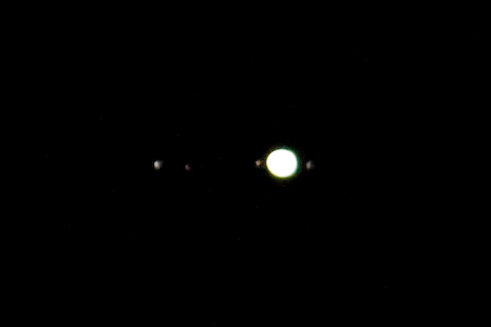
Jupiter and the Galilean moons: (l to r) Ganymede, Callisto, Io, Jupiter, Europa
For those of you playing along at home, the magic settings were 1/25@f/4, ISO800, and a 560mm focal length (ignoring FOV crop).
To get more detail, I’d need darker skies, a much better tripod, a motor-driven tracking system, and, of course, a longer lens. For materials on hand, I think it turned out all right.
Recent Comments