Books: Treasures, Tools, or Trophies?

April 8th, 2010 1 comment

I love books.

I love reading books.  I love holding books.  I love being among great collections of books.

Perhaps not surprisingly, I own a lot of books.

Part of my library, ca. 2007

Part of my library (early 2008)

I could easily borrow what I wish to read from a library.  I could get much of the relevant information from reference texts online.  I could go electronic with a Kindle or Nook.  But I don’t.  I like to own physical books.

I do read a tremendous number of electronic articles and short-form works on my computer, but certain applications still are best served by ink on dead trees.  Part of this has to do with their visibility and accessibility.

Book lovers tend to enjoy inspecting the collections of other readers, partly to find common ground and partly to gain personal insight.   The books can be causally pulled from the shelves, perused, discussed, borrowed, and loaned.  When my collection is observed, I want the message to be clear: what you see is me, not fluff.

My book collection can be divided into three categories: treasures, tools, and trophies.

The treasures are tomes that I find particularly enjoyable.  Favorite novels make up most of this group.  I keep them as reminders of who I am.  I keep them because they feature subjects, characters, or situations with which I identify strongly.   I keep them in the hope (fantasy?) that I’ll read them again someday.  I keep them because they are cherished gifts; they represent valued real-world relationships.

The tools tend to be reference works, how-to guides, and the like.  They are the books that I almost never read cover-to-cover, but I find myself going back to them on a regular basis to assist me in accomplishing a task.  Even in this age of Google and Wikipedia, these volumes continue to earn their places on my shelf.

The trophies are kept around to feed my ego or make the room look better.  They are mediocre, boring, error-riddled, irrelevant, poorly written, out-dated, over-rated, or infuriating.  They will never be opened again.  But they are famous, or they have good “shelf presence,” or they are bound in an eye-catching way.  They are for posturing.  They say, “Look at me!  Look at how well-read I am!”  They are lies.

I’m doing my best to rid myself of my trophy books.  They are a pain to move and store, and my retention of them is irrational and presumptuous.

Still, it’s difficult to actually let go.  I was raised to hold books in high regard.  Getting rid of a book — even a trophy, even one that I really hate — remains challenging.  I feel as though I’m committing a great crime against Knowledge or that I’m personally insulting the author.  I worry that I might need the book in the future.  I tell myself that maybe, just maybe, I’ll read it again someday and think differently of it. I worry about the book’s fate: will it be acquired and loved by somebody else, or will it be killed in the metal jaws of a shredder?

It’s best to do the deed quickly.  Get the volume out of sight.  Let it fade from memory.  After all, if the decision turns out to be regrettable, another copy will always be available.
From the company that promoted “copy and paste” as a new feature in 2009

April 7th, 2010 1 comment

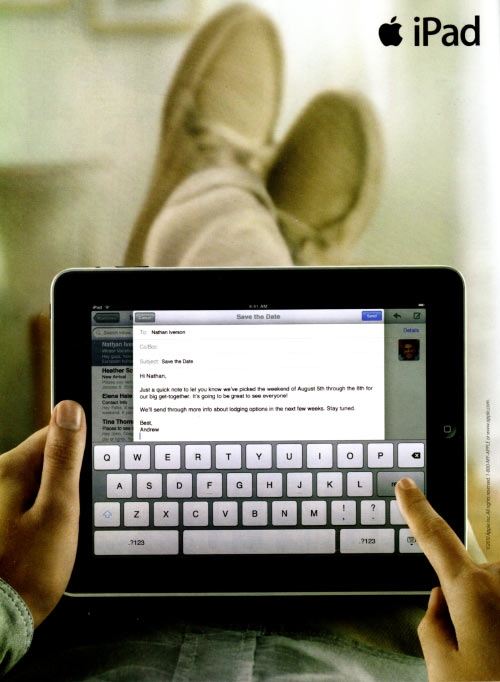
You probably thought that the killer app for the iPad would be something related to books, newspapers, or games, right?  You’re mistaken.  Apple has something even more ground-breaking in mind!

On the back of this week’s New York magazine, we find the ad showcasing the feature that will change the world:

That’s right, it’s some guy (with his feet up, natch) who is using the amazing, incredible, revolutionary, multimedia machine that is the iPad to… send a short email.

Great.

Into the Wild

March 21st, 2010 2 comments

A few years ago at Stanford, I learned about the movie Into the Wild from my roommate Eric.  He rented it, and I noticed a few seconds out of the corner of my eye.  Then it passed out of memory until the recent reemergence of my wanderlust

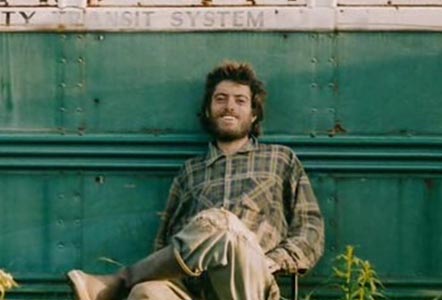
I finally got around to reading the book on which the film is based, which is itself an extended version of an article that first appeared in Outside magazine called “Death of an Innocent.”   It recounts the life and eventual death of Chris McCandless, who gave up a life of privilege after graduating from Emory and chose to live as a tramp.  Eventually, he ended up in the Alaskan bush, where survived for over 100 days before succumbing to starvation. (Coincidentally, Eric looks quite a lot like Emile Hirsch, who plays McCandless in the movie.)

Chris McCandless in front of the bus in which his body was found.

Chris McCandless in front of the bus in which his body was found.

Although the book is well-researched, and the movie is enjoyable, I found it difficult to relate to the protagonist.  Chris is clearly a smart kid, with Harvard Law apparently within his grasp, but his thirst for adventure and extreme overconfidence serve to put him in situations that are intractable, perhaps even selfish.  I can’t see myself having the same disregard for my safety.

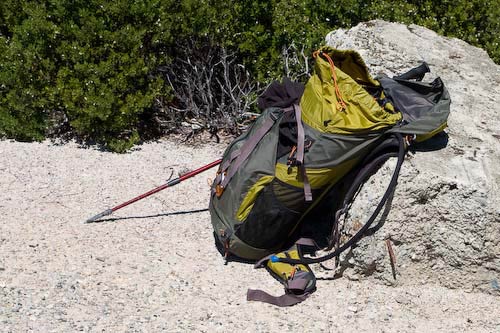
My experience in the wilderness (many weeks spent backpacking and canoeing beyond the range of cell phones) and education as a boy scout (Eagle Scout here) has led me to embrace minimalism in my gear, true, but I don’t go out there bare-skinned.  I give considerable thought to my equipment.  I bring topographic maps, I bring sufficient food, I bring clothing and shelter adequate for the conditions.  When I go, I am prepared.

My backpack

My backpack during a trip in Big Basin, California

I will concede that there is a certain appeal to survive with little more than a sharp hatchet.  If you were to stick me in northern Minnesota — ill-equipped — and challenge me to survive off the land, I’m reasonably confident that I could pull it off.  In the worst case, other humans would never be more than a few hours away.   However, based on personal experience and watching lots of Survivorman, I’m doubtful that it would be a comfortable existence.  And if it were in a place less hospitable, like northern Canada, I’m not sure that I would make it out alive.

Survival, of course, is always my goal.  I want to experience adventure.  I want to go deep into the wilderness.  I want the reminders of civilization to be nothing more than the pack on my back.  I want to take risks and scare myself.  But I want to come home when it’s done.  Unlike Chris, I am not running from anything. When I go, I go for the sake of entertainment.

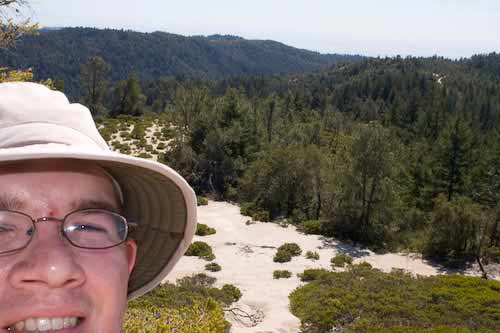
Looking out from the peak

Looking out from a peak towards the Pacific in Big Basin, California

Chris entered the Alaskan bush near Denali National Park along the Stampede Trail.  He was intentionally ill-prepared, having neither the proper clothing for early-season Alaska nor a safe reserve of food.  He wanted to go somewhere “unmapped,” so he didn’t bring a map.   His only concession to reality was his provisioning of a rifle and ammunition, but even those were poorly chosen.

I mean, if hunting is to be one’s primary source of food, wouldn’t one want the ability to reliably take large game?  And if that’s the case, wouldn’t a high-power rifle be appropriate, like perhaps a .30-06?

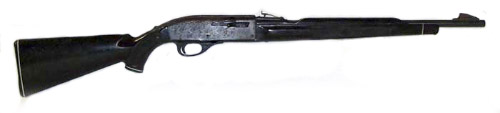
Not for Chris.  Chris took a Remington Nylon 66, which fires a .22 LR cartridge.  Surprisingly, he managed to bring down a moose with a gun that’s better suited for squirrels — before losing the moose meat to flies and wolves due to improper preservation.

Remington Nylon 66 rifle (.22 caliber)

Remington Nylon 66 rifle (.22 caliber)

In the end, McCandless was done in by what biographer Jon Krakauer suspects was the fungus R. leguminicola.  That fungus produces the alkaloids slaframine and swainsonine that, among other things, interfere with digestion, ultimately leading to starvation.  He was found dead by moose hunters in August, 1992.

Was it arrogance that killed Chris?  Bad luck?  Would he have been so cavalier if he hadn’t discovered the old bus he used as a shelter?

I will endeavor to do better on my journey.

Risk, revisited

March 16th, 2010 Comments off

The more I value something, the more unwilling I am to risk damaging it.

Yet, I wonder if my unwillingness to gamble with what I value is itself the more corrosive agent.

Today’s downtime

March 13th, 2010 Comments off

Sorry about the downtime, folks.  The server that runs this web site (and many others) experienced about 90 minutes of unavailability this evening.

Basically, Apache was tuned incorrectly, a particularly slow dynamic page was getting a lot of requests, and the number of Apache processes grew to a point where the system ran out of RAM.  In an unfortunate coincidence, that was almost exactly the same time that the MSN, Yahoo, Google, and Cuil crawlers all started hitting the site almost simultaneously.  The backlog of connections grew, the system was swapping like mad, and the load average hit triple digits.  Everything came screeching to a halt.

A few minutes later, when an automated alert tipped me off that something was amiss, I nearly had a heart attack trying to deal with the horribly unresponsive system.  Thankfully, I got a handle on the situation.

My initial fear of a malicious attacker appears to be unfounded.  I’m doing a thorough analysis to be certain.

Thanks to the people who emailed me about the outage.  Automated monitoring tools are in place, but when it comes to things like this, I’d rather get a few redundant messages than have the problem go undiscovered for hours.  If you happen to notice strange downtime in the future, please don’t hesitate to shoot me an email, IM, or text (preferred).