News Flash: History Repeats Itself

October 6th, 2008 3 comments

With the front-month contract for light, sweet crude at $87.81 today, oil has fallen over 40% from its high last July.  In other words, this oil bubble seems to have popped, providing vindication for those analysts who said that the rapid rise in oil prices was unsustainable.  It also made fools of those who had forgotten or ignored what happened after a similar price spike in the early 1980s.

The drop is bittersweet.  On one hand, it eases the pressure on the budgets for low- and middle-income families around the country.  As a grad student, I certainly have felt the impact on my wallet.

On the other hand, it reduces the drive to find alternative energy sources by eliminating much of the economic motivation.  It means less money will be spent on mass transit.  It means consumers will be less likely to buy efficient vehicles.  It means that industrial companies will feel less pain from having production facilities overseas (which incur high shipping costs), and thus it means that one more salve for the atrophy of America’s industrial might will be removed.

Cheap oil cannot last forever; some day, it will be so expensive as to no longer be a viable source of energy.  By having that day of reckoning pushed back, we have been deprived of an opportunity to lead the charge towards alternatives.  Somebody, somewhere, someday will solve those problems, but those of us living with cheap oil will not have the chance.

Note to my future self

September 26th, 2008 1 comment

It’s easy to get lost in the libraries at Stanford.  Though not the largest university library system, it still holds almost 9 million volumes.

I was wandering through the stacks in the Green library today.  Many books appeared to have gone years without feeling the loving touch of human hands.  The situation called for an experiment: how ignored were the volumes?

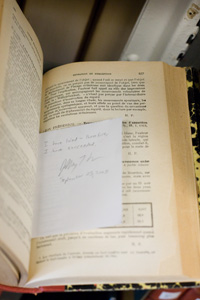
I went to an obscure corner of the library and selected a very old book, one that seemed to have sat idle since not long after its 1923 printing.  I opened it to a random page and slipped in a note to myself:

The note says: “I have tried — therefore, I have succeeded.  <Signed> Jeff Keacher, September 25, 2008”

I plan to visit the book again, some time in the future, to see if the note remains in place.

Zoitz, again

September 6th, 2008 4 comments

Yet again, just when I think about mothballing the project for good, a new influx of traffic hits my webcomic, Zoitz.  I keep thinking that its 15 minutes of fame should have expired long ago, but it seems to have remarkable staying power.  This time, the traffic is largely to a strip that pokes fun at the career opportunities for English majors.

The comics in the series have now been viewed by about a million unique visitors, driven mostly by popularity on Stumbleupon, multiple front-page appearances on reddit, and a mention in a front-page story on Slashdot.  Thanks to everybody who’s added a link!

I wonder how I can develop funny ideas with greater regularity.  I’ve tried brainstorming techniques like mind-mapping, but the bits that have gained traction have all come to me in moments of inspiration:  I see the joke instantly as a completed entity.  It seems like there must be a more efficient to develop funny ideas.  How do the other artists and writers do it?

Related problem: how to monetize the strip without destroying its soul.

One year and counting

September 5th, 2008 Comments off

Time is marching on.

A year ago today, I was settling in for my first night at Stanford.  It seems so far in the past and at the same time, so recent.

The past 52 weeks have brought me new friends, a rejuvenated interest in photography, much knowledge, and a modicum of fame.  Most important, it has been a time of personal discovery and reflection — refining not only who I am, but who I want to be.

In about three months, I will be done with grad school.  What then?  I’m looking forward to the surprise.

Jupiter and moons

August 30th, 2008 2 comments

I was driving home this evening and noticed that Jupiter was particularly bright in the sky.  After a few moments of marveling, I thought, “Hey, it would be fun to see the Galilean moons!”

My 10×25 binoculars didn’t quite cut it.  I could see the planet, of course, but I couldn’t make out any of the moons.  Time for a bigger hammer.

I got out the 400/2.8, a 1.4x TC, a 40D, and a wholly inadequate tripod.  How inadequate?  The camera, lens, and extender together weigh something like 15 pounds.  I normally use that combination with a very sturdy monopod, but a monopod isn’t good for astrophotography.  That meant putting the 15-pound load on a tripod that’s rated for about 3 pounds.  Needless to say, I kept a firm grip on the lens at all times.

I went to one of the outdoor stairways in my apartment building, set everything up, and pointed the lens towards the heavens.  I wasn’t really sure what exposure to use, so I started with 1/200@f/4 and ISO 800.  Not even close.  More fiddling: 1/100@f/4 and ISO 1600.  Better, not there yet.   Finally, I hit on something that worked:

Jupiter and its moons
Jupiter and the Galilean moons: (l to r) Ganymede, Callisto, Io, Jupiter, Europa

For those of you playing along at home, the magic settings were 1/25@f/4, ISO800, and a 560mm focal length (ignoring FOV crop).

To get more detail, I’d need darker skies, a much better tripod, a motor-driven tracking system, and, of course, a longer lens.  For materials on hand, I think it turned out all right.