Conventional wisdom holds that those looking to cut body fat should eat less and exercise more. Only half of that is true, according to a new study. The investigators observed 661 adolescents and found that body fat percentage is negatively correlated with energy intake.
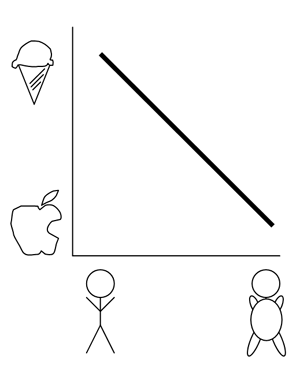
[Figure: Gross oversimplification of study concept: eat more to be skinny]
Physical activity, time watching television, and protein in diet? None were predictors for body fat once corrected for caloric input.
So what’s going on? Does this mean it’s time to stuff yourself with ice cream? Hardly. A restrictive diet leaves you too tired to exercise. High energy ‘throughput’ is the key to a lean body.
[via]
(This post is part of the 100/100/100 challenge)
Me: celebrating a quarter-century of existence! And it just keeps getting better…
(This post is part of the 100/100/100 challenge)
Sometimes things fall into the category of “it’s funny because nobody died.” Those same things usually are also in the “I wish I could have been there to see it” category. A 4500-psi air tank becoming a missile? That fits the bill.
Ironically, the air tank was loosed as a result of a poorly-executed safety demonstration.
(This post is part of the 100/100/100 challenge)
It seems that green tea is unhealthy in large quantities. At first, I was concerned, since I’ve been on something of a tea kick lately. Then I discovered that “large quantities” meant “more than 10 cups a day.” Whew!
The office provides a plethora of teas for employee caffeination, so I indulge. In truth, I haven’t drunk much green tea lately. Instead, I’ve gotten my fix from Good Earth’s Original Blend. Mmm. Good stuff. I think the Brits are onto something with their afternoon tea…
(This post is part of the 100/100/100 challenge)
The stock market has an annual rate of return of 10%, so says popular belief. That’s great for pretty charts, but don’t bet your retirement on it.
The problem is that while the long-term average return might be 10%, the return in a particular period might be significantly different. Dr. Sam Savage wrote an excellent article on this topic. As he points out, retirement-year choice can be crucial.
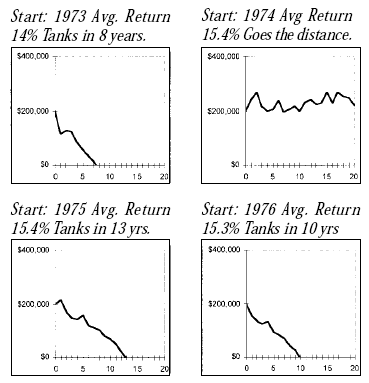
[Figure: A fund can fail even with above-average returns (source)]
Unfortunately, the article is a bit light on practical responses. One possibility: save more, spend less.
(This post is part of the 100/100/100 challenge)
Recent Comments