Pepsi versus Pepsi: the new Pepsi Challenge

February 27th, 2009 40 comments

There I was in Target, picking up some mundane supplies, when a display on an aisle end cap caught my eye: four-bottle packs of Pepsi Natural.  Having ventured out from under my rock every once in a while, I was familiar with regular Pepsi, Diet Pepsi, Pepsi Max, and even Crystal Pepsi, but Pepsi Natural was new to my eyes.  Curiosity was running through me like so much caffeine. What was this Pepsi Natural?  How would it compare to the standard, plebeian product?

In one swift move, I snapped up a four-pack, swung around, and snagged a bottle of regular off of the nearby shelf.  It was time for a new Pepsi Challenge, Pepsi on Pepsi.
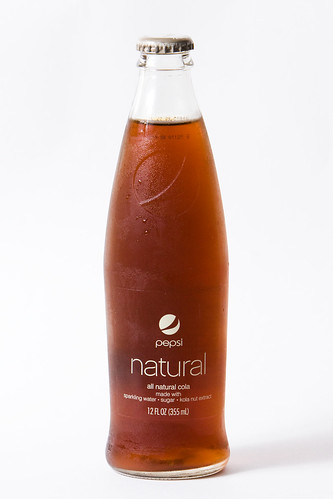
Pepsi Natural

The first thing I noticed, other than the fact that the “natural” variant was housed in glass bottles while the regular was in plastic, was the price difference.  Including the CRV, the traditional Pepsi 2-liter rang up at $1.89, while the four 12 fl oz bottles of Pepsi Natural set me back $4.69.  Scale that, and you’ll find that regular runs $3.69 per gallon, while super-ultra-premium-natural goes for an astonishing $12.50 per gallon.  $12.50 per gallon!  For sugar water!  Yes, yes, I realize that bottles might affect the price, but should the glass privilege be worth that much?  I mean, that price is in the bottled-beer neighborhood.  Perhaps the contents would justify the difference.

Pepsi Natural is billed as being “all natural” and made with “sparkling water, sugar, and kola nut extract.”  Indeed, the ingredient list has all that and more.  Compared to the normal Pepsi, we find a different sweetener, a different type of fizzy water, an additional color source, different acids, and the addition of the kola nut extract.
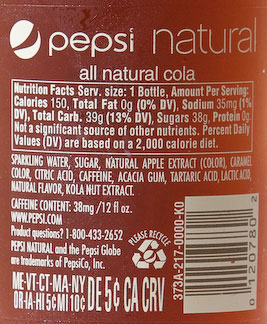
Pepsi Natural ingredients
Pepsi Natural ingredient list

The most noticable difference is the exclusion of high-fructose corn syrup (HFCS) in favor of sugar alone.  Some people have made a ruckus in recent years about the virtues of soft drinks sweetened with sugar instead of HFCS.  Most major cola manufacturers made the switch to HFCS in the early 1980s, but some still have small production runs with the old-fashioned sweetener.  Supposedly, Mexican Coca-Cola is sweetened that way, as is some Coke imported for Jewish customers.  Supposedly, the taste is different (better), and possible health effects from HFCS are avoided (never mind the phosphoric acid).  Would the difference be noticable here?  Perhaps not, as regular Pepsi includes both regular sugar and HFCS.

One must also be aware that “natural” doesn’t mean “direct from a plant” or even “organic”; rather, for natural flavors, the chemicals were derived from something that was alive at some point rather than a source like petroleum or coal tar, which are “artificial.”  Either way, you can bet that they went through a lot of processing and refinement before they met the bottle.  Most of the minor ingredients in Pepsi Natural seem to have fairly straightforward routes from plants to bottles, but “natural flavors” remains unappealingly ambiguous.

Enough of that. Time for the taste test.

I let both the regular and natural Pepsi colas chill in the refrigerator overnight.  The next day, I brought them out and poured a glass of each.  Temperature at consumption: 57° F.

The first difference I noticed was the color.  Both were brown, caramel-colored, and clear.  However, the natural Pepsi was much lighter than the regular.  Presumably, the difference was intentional, as they both contain coloring agents.
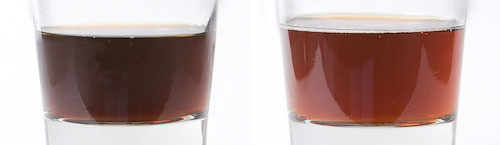
Pepsi colors (left: regular, right: natural)
Pepsi colors: regular on the left, natural on the right

The next difference was the smell.   While the regular cola had a sweet, somewhat acidic scent, the natural version had barely any smell at all.  Perhaps that was related to the relative effervescence of the drinks: the regular appeared far fizzier, which might have released more aromatic compounds into the air.

Time for a sip.  While the regular version had a biting, acidic feel, the natural felt smoother and more mellow.  The regular mouthfeel was inferior, being somewhat astringent.  There was a grittiness on my tounge and teeth with the regular version that seemed absent with the other.  Overall, the taste profile was very similar.  I think that the natural version had hints of cognac, but even in the non-blind test the two drinks were difficult to distinguish.  Later, a couple of my friends also used the adjective “smoother” when describing Pepsi Natural versus regular Pepsi.

To take carbonation and the differing acids out of the picture, I added 1.2 g of sodium bicarbonate to 180 ml of each soda.  The liquids fizzed madly, then went silent.  I tried each of the now-flat drinks, and they tasted virtually identical: two cloyingly sweet, syrupy brown liquids.  The underlying chemistry and provenance of the sweeteners are very different, but the tastes are pretty much the same.

Regardless of the form, the drinks contained what seemed to be an unhealthy amount of sugar.  Pepsi Natural has slightly less sugar in a 12 fl oz serving, with 38 g versus 42 g for regular, but that’s still nearly a quarter of a cup by volume of crystallized sugar:
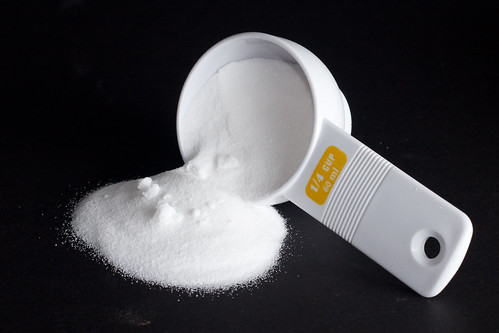
Amount of sugar in 12 fl oz of Pepsi (42 g)

Will Pepsi Natural find a permanent home in the market?  Hard to say.  History is littered with failed soft drink sub-brands.  The price differential could be an issue, too: when money is tight, who is going to blow the budget by buying “natural” soda?

Frankly, I find all soft drinks to be far too sweet, and the fizziness is unappealing.  I probably consume no more than a quart of soft drinks of any type in a given year.  In fact, I could finish neither of the sample glasses, so most of the carmel-colored gold went down the drain.

In this Pepsi challenge, I’ll choose option (c): still water.  Tastes better, much healthier, and a lot cheaper.  And all natural, too.
Photographing the Tour

February 17th, 2009 2 comments

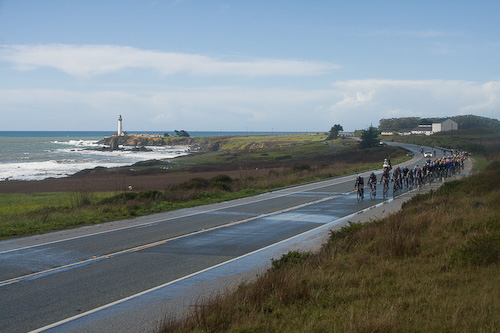
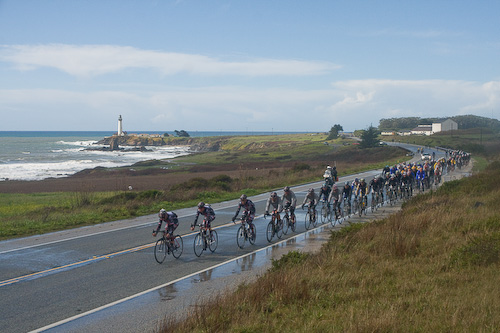
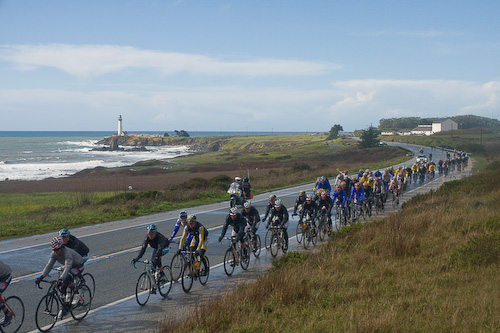
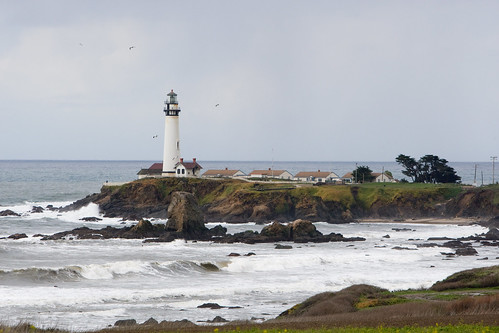
This morning, I photographed Stage 2 of the Tour of California (think Tour de France, but in California).  Because of the speed of the riders and the difficulty of travel, I had to chose a single location.  After scouting along the mountainous Tunitas Creek Road, I settled on a spot next to my favorite California lighthouse: Pigeon Point.

Pigeon Point Lighthouse
The Pigeon Point Lighthouse

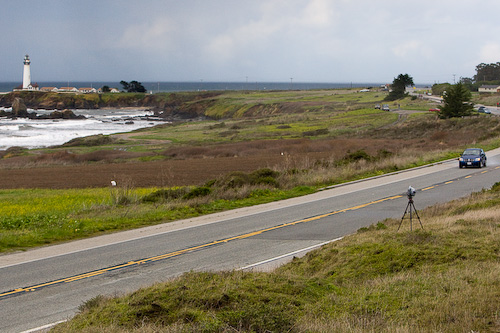
My plan was to have two cameras: one radio-triggered remote with a wide-angle lens, and one handheld with telephoto glass.  Each of them would be framed so that both the riders and the lighthouse would be visible.

The lighthouse was the deciding factor in my choice of location.  Although the climb on Tunitas is beautiful, it is really nothing but a nondescript climb in a thick forest.  That could be anywhere.  The Pacific coast?  Well, there’s only one of those.

My remote camera
My remote camera (wrapped in plastic) in the lower right

The weather was dismal: rain, wind, and cold.  Fortunately, the conditions changed by the moment: there would be a downpour, and then all of a sudden, it would be sunny.  Then I’d see another squall barreling towards me over the ocean, and it would be raining again.

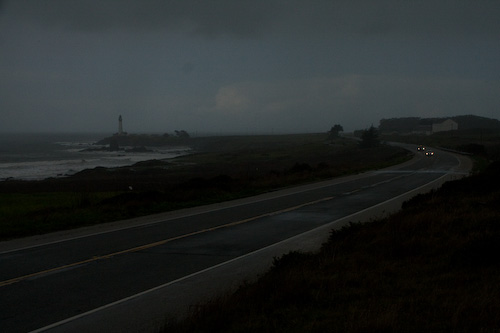
After a wonderful dry spell, just after the first advance vehicles from the Tour passed me, torrential rains made landfall.  I had hastily wrapped my remote camera in a zip-top bag, added a makeshift cinefoil hood to its lens, and gaffer-tapped the mess up tight.  My other camera went into a big garbage bag with a hole for the lens.  Who needs those expensive covers?  Everything stayed perfectly dry, even in the worst of it:


Rain!!!

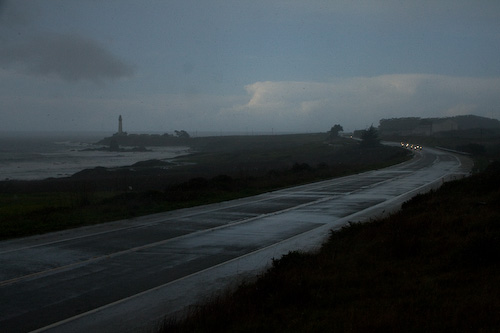
All of these are from the remote camera, hence the identical framing.  Gradually, the rain began to subside:


A little better…

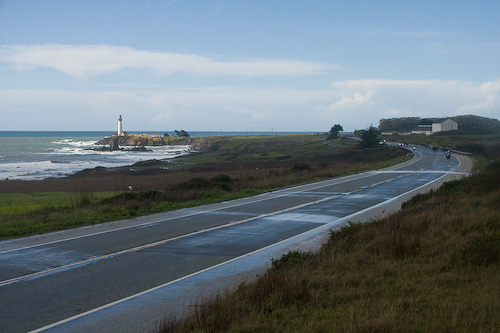
Then, like magic, the clouds parted and the sun emerged — right as the peloton approached.  It was so remarkable that I feel compelled to show it visually:

Amazing!

After that, the storms seemed to disappear, and it became a very pleasant day.  I hope the weather holds for the riders as they continue along the Tour tomorrow!

I’d like to thank…

January 28th, 2009 3 comments

Some of you may be familiar with the work of William Gosset, though not his name.  Gosset was working for the Guiness Brewery about 100 years ago when he came up with the t-distribution.  However, he could not publish under his own name, so instead he used the name “A Student.”  Unfortunately for Gosset, the name stuck, and we now know that result as Student’s t-distribution.

Ok, great.  But are you familiar with the story of M. A. Poubelle?  A Google Scholar search shows that Marie-Antoinette Poubelle is the first-listed author of a number of papers, with an especially prolific period in the mid 1980s.  However, Mme. Poubelle does not exist.

It’s a story that seems to have been floating around grad student circles while remaining surprisingly absent from the web: the other authors of those papers were acknowledging the contribution of… their trash can.  Yes, “ma poubelle” is French for “my trash can.”

I propose a challenge to you publish-or-perish types out there: do something equally clever in a paper that you write.  Bonus points if it gets people to read your paper all the way through.  Super mega bonus points if it gets people to at least glance at your dissertation!

Evidence

January 22nd, 2009 8 comments

Let’s say you have high cholesterol, but you don’t have atherosclerosis.  Your doctor recommends you pop a pill, probably a statin, likely Lipitor.  Will that be beneficial for you?

Probably not.  On top of that, it represents an enormous expense for you and your insurance company.

Wait… what?  Yes, it turns out that taking a statin is unlikely to prevent you from having a stroke or heart attack.  The advertisements say as much, albeit in small print, but that hasn’t stopped numerous doctors from prescribing them to people whose cholesterol numbers are “too high.”  In fact, according to a survey of statin clinical trials undertaken by the Therapeutics Initiative at the University of British Columbia,

“If cardiovascular serious adverse events are viewed in isolation, 71 primary prevention patients with cardiovascular risk factors have to be treated with a statin for 3 to 5 years to prevent one myocardial infarction or stroke.”

Doesn’t seem like a very good return on investment to me.  What’s more, it seems that many of the people in these studies have poor diets and get little exercise; to my knowledge, a proper study comparing statins to improved diet and exercise has not been undertaken.

One other evidence-based pearl: treatment with stimulants (e.g., Ritalin)  of children diagnosed with ADHD appears to do little except make the children shorter and weigh less.

Of course, people continue to demand antibiotics to treat viral infections, so maybe they just don’t care about actual science.  (Ironic that I’d finish with an apocryphal statement, eh?)

Enjoy the moment

January 20th, 2009 3 comments

Pop quiz: You’re observing a once-in-a-lifetime event.  There is plenty of professional media around, and their photos will be readily available afterward. What do you do?

  1. Take a photo
  2. Enjoy the moment
  3. Miss it because the jerk in front of you spilled his drink on your shirt

All too often, people choose the first option.  Instead of enjoying the moment, they make a misplaced effort to take a snapshot.

I noticed this while watching the Obama inauguration today.  Throngs of people, cell phones and compact cameras held high, looking at LCD screens instead of what was right in front of their eyes.  Did they really think that they could get better photos than the professional photojournalists who shot with superior vantage points, superior expertise, and superior equipment?  Why distract themselves just to make an inferior product?

Some events are meant to be enjoyed, and others are meant to be recorded.  Similarly, there are many beautiful things in this world, but not all of them work well in the photographic medium. I find that if I attempt to split my attention between photography and enjoyment, both suffer.

The Grand Canyon is well known as a subject for photographs.  However, the images I captured during my time there were halfhearted.  I made a few, sure, but I made a conscious decision to stow my camera for most of my hike.  I was more concerned about experiencing the canyon, hiking between the rim and the river.  It was beautiful.  Attempting to capture that beauty would have ruined it for me.

Yes, I acknowledge the value of pictures in jogging memories.  In certain social situations, where I am one of the participants and there is no press corps standing by, I will take snapshots of my friends and me.  Even then, I am careful not to let photography become the focus of the event.  But a fleeting moment that is better covered by others? No.

Knowing when not to take photos can be just as important as knowing when to snap the shutter.